Where the Buddha Meets the Brain: The Neuroscience of Letting Go
The Science of Suffering: How Neuroscience Confirms Buddhist Insights on the Mind
More than 2,500 years ago, a man sitting quietly beneath a tree made one of the most profound psychological discoveries in history. The Buddha observed that life inevitably includes pain, loss, and uncertainty — but that the suffering we experience is not caused directly by these events. Instead, suffering arises from the mind’s resistance to reality: our clinging to what we want, and our aversion to what we don’t.
In Buddhist philosophy, this is the essence of dukkha — not just pain, but the dissatisfaction that shadows even our happiest moments. It’s the subtle tension of wanting life to be different from how it is. What’s remarkable is that modern neuroscience is now uncovering, in measurable detail, the biological mechanisms that underlie this ancient insight.
The Neuroscience of Clinging and Aversion
Brain imaging studies over the past two decades have shown that when we experience emotional pain or distress, the regions most active are not only those processing the original stimulus — like the sensory cortex — but also those constructing a story around it. The prefrontal cortex, responsible for evaluation and prediction, lights up as the mind replays and resists what happened. The amygdala, our emotional alarm center, amplifies fear and anxiety.
In other words, much of our suffering is secondhand: not the event itself, but the cascade of reactions it triggers. Neuroscientist Judson Brewer, who has studied mindfulness for addiction and anxiety at Brown University, calls this “the habit loop of suffering.” Something unpleasant arises → the mind reacts with craving or avoidance → this reaction becomes its own source of distress.
The Buddha described the same process in his teaching of the “two arrows.” The first arrow is the unavoidable pain of life — the body ages, losses occur, things change. The second arrow is the one we shoot ourselves: the mental anguish, resentment, and fear that arise from not wanting things to be as they are.
Mindfulness as Neural Rewiring
What happens when we interrupt that loop — when, instead of reacting, we simply observe? Studies from neuroscientists like Richard Davidson at the University of Wisconsin show that mindfulness and compassion meditation literally reshape the brain. Regular practice reduces activation in the amygdala and increases gray matter density in regions associated with emotional regulation, attention, and empathy.
In other words, mindfulness changes not just how we feel, but how our brains are wired to process experience. It trains the mind to notice thoughts and emotions as transient phenomena rather than as defining truths. Over time, this loosens the grip of craving and aversion — the very forces the Buddha identified as the root of suffering.
A Convergence of Insight and Experiment
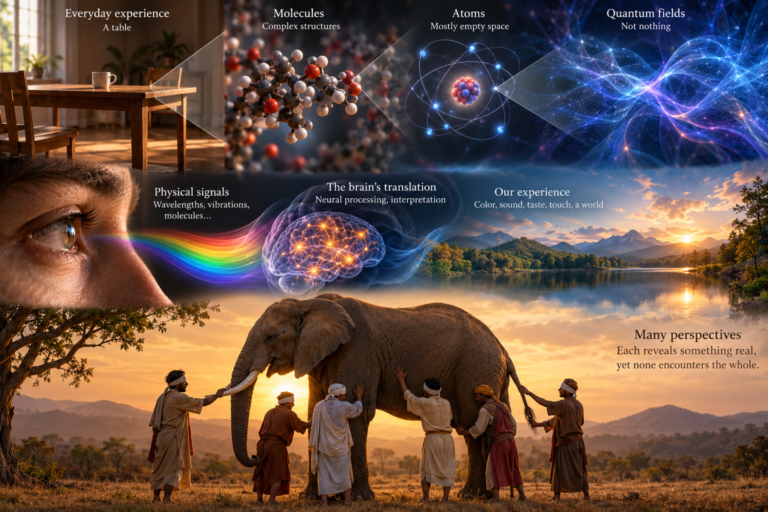
What’s fascinating is how two entirely different methods — introspective observation and empirical science — are converging on the same conclusion: that the mind constructs much of the reality we suffer from. The Buddha arrived there through direct meditative insight; modern scientists reach it through fMRI scans and data analysis.
Yet both are uncovering the same architecture of human experience: that perception is not passive, that thoughts are not facts, and that freedom is possible through awareness. The Buddha offered this as liberation; neuroscience frames it as neuroplasticity — the brain’s ability to change itself through conscious practice.
The Inner Laboratory
Perhaps the next frontier in science is not outer space, but inner space — the exploration of consciousness itself. The laboratory of meditation, after all, is as rigorous as any experiment: it tests hypotheses about suffering and happiness, observes cause and effect, and draws conclusions verified through direct experience.
As the Dalai Lama once said, “If scientific analysis were conclusively to demonstrate certain claims in Buddhism to be false, then we must accept the findings of science and abandon those claims.” This spirit of inquiry — open, curious, and self-correcting — lies at the heart of both disciplines.
Toward an Integrated Understanding
Perhaps what we’re witnessing now is not a collision but a reunion — the rediscovery that ancient wisdom and modern science are different languages describing the same human truth. One uses the microscope, the other uses the mirror of awareness. Both, when used skillfully, reveal the same insight: that by understanding how the mind works, we can be free from its habitual suffering.
In the end, neuroscience may give us the map, but Buddhism gives us the path. The Buddha did not offer theories about the mind — he offered a method to see directly how it creates joy or misery. And that experiment remains open to each of us, here and now, in the laboratory of our own awareness.