Does the Present Moment Exist?
Past, future, and the strange place we call now
What time is it? You might look at a clock and answer. But that wasn’t really the question.
When is it? The obvious answer is: Now. So try to find it. Before you finished reading the word now, the moment in which you began reading it had already become the past. The next moment had not yet arrived. Somewhere between them should be the present. Where is it?
The Vanishing Present
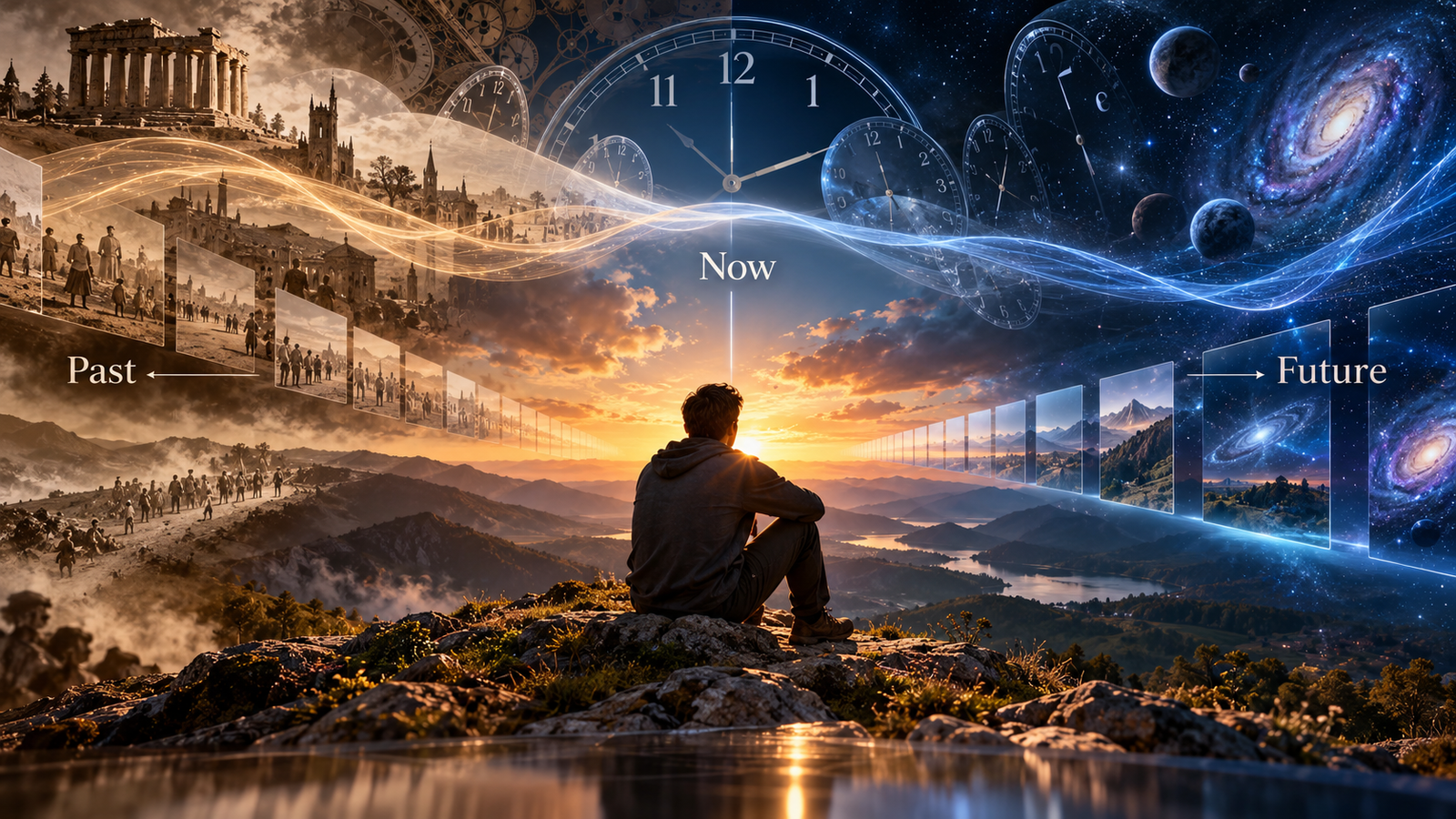
Our ordinary picture of time seems simple. There is the past—the things that have already happened. There is the future—the things that have not happened yet. And separating them is the present—the moment in which reality is happening. We might picture it like this:
Past → Now → Future
But how long does “now” last? One second? Then the first half of that second occurred before the second half. A millisecond? The same problem remains. A microsecond? Divide it again. However small an interval we choose, it still contains an earlier part and a later part.
Keep reducing the interval and eventually “now” approaches something like a mathematical instant—a boundary with no duration of its own. And that creates a peculiar problem. If the present has no duration, how do we experience it?
The Present We Actually Experience
Perhaps we don’t experience an infinitesimal present at all. Consider music. You hear three notes: ♪ da — da — dum ♪ If your experience consisted only of an instantaneous slice of reality, you could never experience the three notes as a melody. By the time the second note arrived, the first would already belong to the past. By the third, the second would be gone as well. Yet you don’t experience three disconnected sounds. You hear a phrase.
Somehow consciousness holds what has just happened together with what is happening, producing an experience with temporal depth. Philosophers have sometimes called this the specious present: the short span of experience that feels to us like “now.” Our experienced present, then, may not be a razor-thin boundary separating past from future. It may be a small window assembled by the mind.
We Are Always Receiving the Past
There is another complication. Everything you perceive has already happened. Look at the table in front of you. Light has to travel from the table to your eyes. Photoreceptors respond. Signals travel through the visual system. Neural processing occurs before the experience of seeing emerges.
At ordinary distances, the travel time of light is negligible. Neural processing takes considerably longer. But the principle becomes obvious when we look toward the sky. The Moon we see is already more than a second in the past. The Sun appears to us roughly eight minutes after the light left it. The light from the nearest star beyond the Sun has traveled for more than four years. And when we look at the Andromeda Galaxy, we see light that began its journey roughly 2.5 million years ago. Astronomy makes something unavoidable: To see is, in some sense, to see the past.
But this is true even when we look across the room. The delay is simply too small for us to notice. So the “now” we experience cannot simply be an instantaneous photograph of the universe arriving directly in consciousness.
It is assembled from information that necessarily reaches us after the events that produced it.
The Brain’s Now
This does not mean our experience is false. It means that immediacy itself may be something the nervous system creates. Think again about the translation analogy from The Emptiness Beneath Everything. Our senses translate physical interactions into neural signals, and the brain organizes those signals into the coherent world we experience.
Perhaps time is part of that organization too. The brain must integrate events occurring over slightly different intervals. Sight, sound and touch do not all arrive and undergo processing in precisely the same way. Yet we generally experience one coherent world. A glass falls, we see it strike the floor. We hear it shatter. and we experience an event.
The nervous system has done something remarkable: it has taken streams of physical information and given us a unified experience occurring now. The experience is real. But the “now” we experience may be less like a timestamp delivered by the universe and more like a temporal window constructed by the brain. And then physics makes the problem stranger still.
Does the Universe Have a Now?
We naturally assume that although our perception might be delayed, somewhere beneath all of this there must still be a universal present. Surely, at this very moment, something is happening everywhere in the universe. There must be one cosmic now. Einstein’s theory of relativity makes that intuition difficult to maintain. For observers moving relative to one another, spatially separated events that one observer regards as simultaneous need not be simultaneous for another. This is known as the relativity of simultaneity.
It doesn’t mean that anything can happen in any order. Causally connected events retain their causal structure. But for sufficiently separated events, physics does not provide a single observer-independent answer to the question: “What is happening over there right now?” There is no universal clock ticking identically for the entire cosmos. No single present appears to sweep across the universe announcing: This is what exists NOW. And that changes the question. Perhaps instead of asking where the universal present is, we should first ask whether the universe contains such a thing at all.
Is the Future Becoming the Past?
Our experience suggests that it does. We feel as though the future approaches us. It becomes the present. And almost immediately slips into the past.
Future → Present → Past
It feels so obvious that we describe time itself as flowing. Time passes. The moment arrives.
The day went by. The future is coming. But what exactly is moving? A river flows because water changes position relative to its banks. A car moves because its position changes over time. But if time itself flows, relative to what does it move? We sometimes say that time passes at one second per second. But that doesn’t explain a mechanism of passage. It simply compares time with itself. Physics allows us to measure durations extraordinarily precisely. It tells us that clocks can run at different rates depending upon motion and gravitational conditions. It describes how events are related in spacetime. But whether time itself literally flows is a different question. Perhaps what undeniably flows is not time, but experience.
Yesterday’s Now
There is a simple way to feel the strangeness of this. Think about yesterday. At some point yesterday you probably said or thought the word: now. At that moment, yesterday wasn’t yesterday. It was now. Tomorrow, if it comes, you will again experience a moment you call: now. The contents of “now” continually change. But “now” itself never seems to become anything else while we are experiencing it. Whatever moment consciousness occupies is always experienced as present. That suggests a curious possibility. Perhaps “now” is not primarily the name of a particular moment in the universe. Perhaps now is the way a moment appears when it is being experienced.
That is a philosophical possibility, not a conclusion established by physics. But it changes how we think about the present. Maybe events do not become real because they enter some cosmic spotlight called “now.” Maybe presentness belongs partly to experience rather than to the universe as a whole.
The Wisdom—and Puzzle—of Being Present
This creates an interesting tension with Eastern philosophy. We are often encouraged to live in the present. Zen practice repeatedly returns attention to immediate experience. The past is gone. The future has not arrived. Be here now.
There is profound practical wisdom in this. Much of human suffering does arise from replaying what has happened or imagining what might happen. But philosophically, there is something almost mischievous about the instruction – Be in the present.
Very well. Where is it? The moment we attempt to isolate it, it disappears. If we give it duration, part of it becomes past and part future. If we reduce it to an instantaneous boundary, it has no duration in which anything could seemingly be experienced. And yet experience continues. Perhaps the wisdom of “being present” was never about locating a microscopic slice of time. Perhaps it means something simpler: allowing experience to occur without continually replacing it with memory, anticipation and narration. The present may be difficult to define. Present experience is not.
So Does the Present Exist?
Perhaps we have been asking one question as though it were several. Does time exist? Clearly, physical processes have temporal relationships. Events have durations and sequences. Clocks measure meaningful differences, and relativity makes experimentally verified predictions involving time. Does a universal cosmic present exist? Relativity gives us strong reason not to assume one. Does the infinitely thin boundary between past and future exist? Mathematically we can define an instant, but whether such an instant corresponds to the experienced present is another matter. Does our experience of now exist? Unquestionably. Something is happening as you read these words. But perhaps the “present” we experience is not a fundamental slice of the universe. Perhaps it is the way consciousness organizes change into an immediate world. And that leaves us in a strange position. We cannot live in the past except through memory. We cannot live in the future except through anticipation. And the present, when we attempt to locate it precisely, seems to slip between them. Yet somehow— here we are.
Where Is Now?
Maybe that is why time remains so mysterious. We know how to measure it with astonishing precision. We can predict how clocks behave aboard satellites. We can calculate the age of stars. We can observe galaxies as they existed millions or billions of years ago. And yet the most intimate aspect of time remains remarkably difficult to explain: Why does this moment feel like now? Yesterday once felt like now. Tomorrow, perhaps, will feel like now. Every moment we have ever experienced has arrived wearing the same label – Now.
Perhaps the present is not something we move through. Perhaps time is not something flowing past us. Perhaps both intuitions arise from the peculiar way consciousness encounters a changing universe. Or perhaps there is something about time we still do not understand. For all our clocks, equations and philosophies, we remain creatures who experience existence from what feels like a moving point called the present. We know it more intimately than almost anything else. And yet when we turn around and try to find it—
now is already gone.