
The Emptiness Beneath Everything
What physics, perception, and Eastern philosophy suggest about the things we call real
Look around you. – a table a wall or a tree outside the window. Your hands resting in front of you. The world appears to be filled with things. Solid & separate things – things that seem unquestionably real. The table is a table. The tree is a tree. You are you. At the scale of everyday life, there is little reason to question any of this. But suppose we keep looking deeper – past appearances, molecules, atoms into the realm of sub-atomic activity. Where, exactly, do we find the thing? And an even more troubling question follows: Do we experience reality as it actually is—or only as a human being is capable of experiencing it?
The Disappearing Table
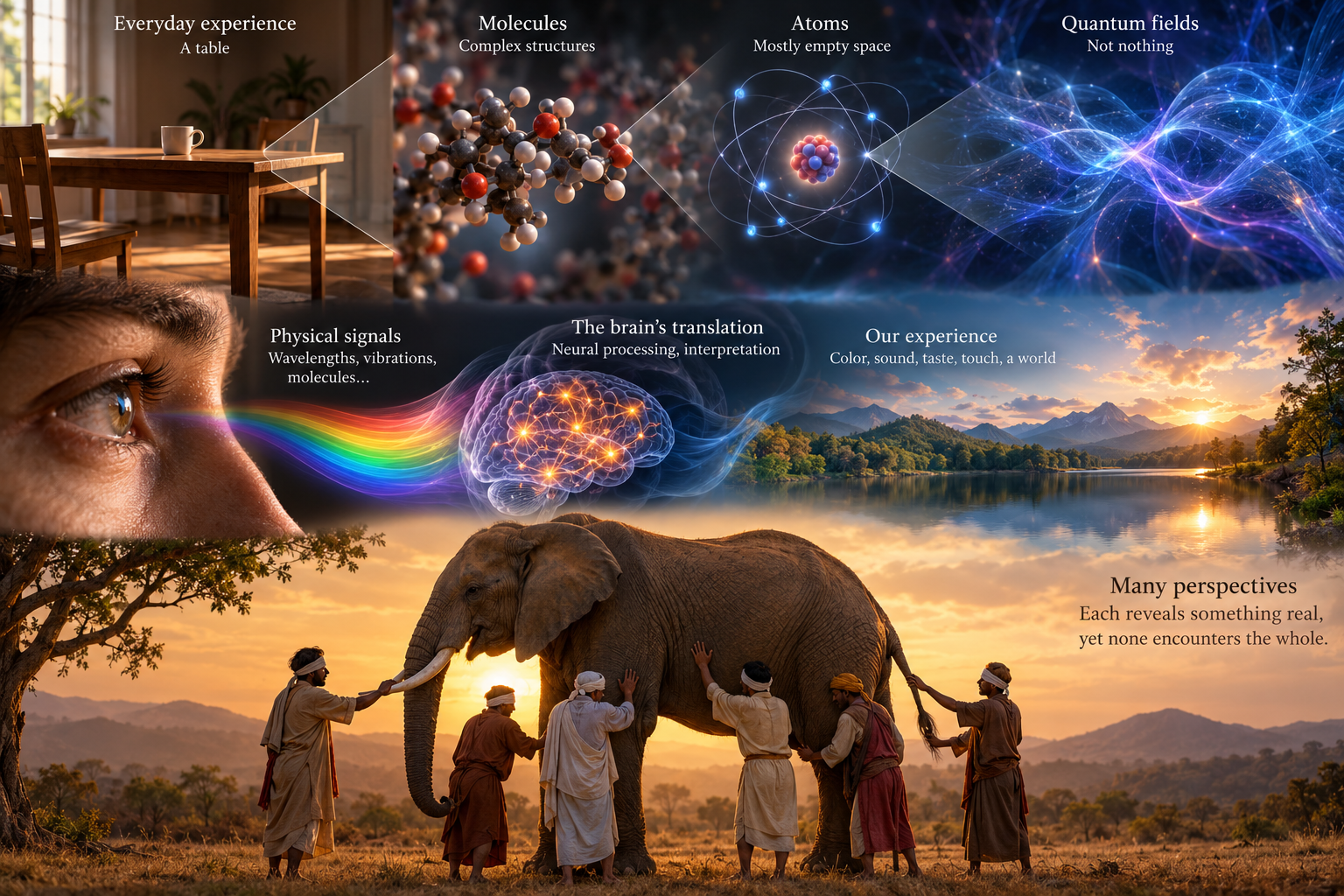
Consider the table in front of you. It feels solid. Your hand cannot pass through it. You can place a cup on it. It occupies space and has weight. There is nothing imaginary about the table. But magnify it far enough and the familiar object begins to change. Wood becomes molecules. Molecules become atoms. Atoms reveal nuclei and electrons. And the simple picture many of us learned in school—tiny pieces of matter resembling miniature billiard balls—gives way to something much stranger.
At the quantum level, matter is described through quantum states, fields and interactions, with measurement outcomes generally expressed probabilistically. The solidity we experience is perfectly real at the scale at which we live. But it is not quite what it appears to be. There isn’t a tiny piece of solid “table” waiting at the bottom of reality.
So where did the table go? It didn’t go anywhere. Perhaps the problem was expecting the table to be a fundamental thing in the first place. And this is where the question becomes more interesting.
And this leads naturally to another thought. If the table is made of molecules, and those molecules are made of atoms, then almost all of the volume we associate with an atom lies between its extraordinarily tiny nucleus and the region occupied by its electrons. What feels completely solid to our hand therefore looks remarkably spacious when examined at the atomic scale. It is tempting to imagine that if we keep looking beneath matter, eventually we must arrive at vast stretches of empty space separating tiny pieces of something solid.
But that raises a deceptively simple question: What exactly do we mean by empty?
Empty Doesn’t Mean Nothing
We often hear that matter is “mostly empty space.” It is an appealing image: tiny pieces of matter suspended in an enormous amount of nothing. But modern physics gives us a stranger picture. Empty space is not simply nothing. Quantum field theory describes fundamental fields extending throughout space. What we call particles can be understood as excitations of those fields. Even the vacuum—the lowest-energy state of those fields—is not philosophical nothingness. So as we move deeper into matter, we do not seem to arrive at a simple choice between something and nothing. Instead, the distinction itself begins to become less intuitive.
Physics does not tell us that nothing exists. It tells us something more subtle. The everyday categories of thing, object, solid and empty may not describe reality at its deepest level.
They describe reality extremely well at ours. And that raises a question that sounds surprisingly familiar. If something can exist without being the permanent, self-contained object it appears to be, what exactly do we mean when we say that a thing exists?
Long before anyone knew about atoms or quantum fields, Eastern philosophers approached that question from a very different direction.
Emptiness Is Not Nothingness
In Buddhist philosophy there is the concept of śūnyatā, usually translated as emptiness.
The word can easily be misunderstood. Emptiness does not simply mean that nothing exists.
Rather, it challenges the idea that things possess completely independent, permanent, self-contained existence. Things arise through causes, conditions and relationships. Consider a wave. Does the wave exist? Of course. We can see it. Measure it. Watch it travel toward shore. But try to separate the wave from the ocean. Remove the water and what remains? Nothing that could independently be called a wave. The wave exists. But it exists through conditions.
Now consider a whirlpool. There is clearly something there. It has a shape. It can persist for some time. It can affect objects that enter it. Yet the whirlpool is not another substance added to the water. It is a temporary pattern of the water. Perhaps much of what we call reality is like this. Patterns mistaken for things. And if that possibility is unsettling, there is another complication. So far we have been asking what reality might be made of. But every conclusion we reach about reality must pass through the same instrument: us.
The World We Never Experience Directly
Even if we could determine what reality ultimately consists of, we would face another difficulty. How would we know that we were perceiving it as it actually is? We never encounter the external world completely unmediated. Light reaches our eyes, vibrations reach our ears, molecules interact with receptors involved in smell and taste, pressure, temperature and other physical interactions stimulate receptors throughout our bodies.
Our sensory systems convert these interactions into electrochemical signals. Those signals travel through neural pathways and are processed by immensely complex networks of neurons. And from all of this arises something extraordinary: experience.
Color, sound, taste, touch, shape or even distance or the whole world. But the world we experience and whatever exists independently of our nervous system need not be identical.
Is Red Really Red?
Consider the color red. We normally speak as though redness exists on the object itself. A red apple is red. But outside us there are surfaces interacting with electromagnetic radiation.
Light reaches the eye. Photoreceptors respond to particular ranges of wavelengths. Neural signals are processed through the visual system. And somehow there arises the subjective experience we call red. The experience is real. But redness as we experience it is not simply sitting on the surface of the apple waiting to be collected by the eye.
Something similar happens with sound. Outside us there are pressure variations traveling through a medium. Yet we don’t experience pressure waves. We hear a violin, thunder, laughter, or a human voice. Somewhere between the physical event, the sensory organ and the brain arises the world as we know it. This doesn’t mean the external world is imaginary.
It means that our experience of it is a translation. Perhaps language offers a useful analogy.
A beautiful poem can be translated from one language into another. The translation may preserve its meaning remarkably well, perhaps even much of its beauty. But it can never be assumed to be identical to the original. A rhythm may change. A word may carry associations for which another language has no exact equivalent. A cultural reference or ambiguity may survive only imperfectly. The translation can be faithful without being the original. Perhaps perception is similar. Our senses and nervous system may give us an extraordinarily effective translation of reality—effective enough to navigate the world, build civilizations and investigate the cosmos. But we should be careful about assuming that the translation contains everything that was present in the original.
And different biological systems perform that translation differently.
Which Creature Sees the Real World?
A bee can perceive ultraviolet wavelengths invisible to us. Dogs inhabit an olfactory world enormously richer than ours. Some snakes can detect infrared radiation. Other animals respond to electric or magnetic fields that humans do not consciously perceive in comparable ways. They inhabit the same physical universe. But they do not experience the same world.
So which creature perceives reality as it truly is? Perhaps none of them. Perhaps each nervous system samples certain aspects of its environment and constructs an experience appropriate to the organism possessing it. Human beings may simply be another example.
Our senses are remarkably effective. They have allowed us to navigate our environment, cooperate, build civilizations and eventually create instruments capable of detecting aspects of reality our senses cannot perceive directly. But usefulness does not guarantee completeness. Evolution needed organisms capable of surviving within reality. It did not necessarily need organisms capable of experiencing reality exactly as it exists in itself.
The World the Brain Gives Us
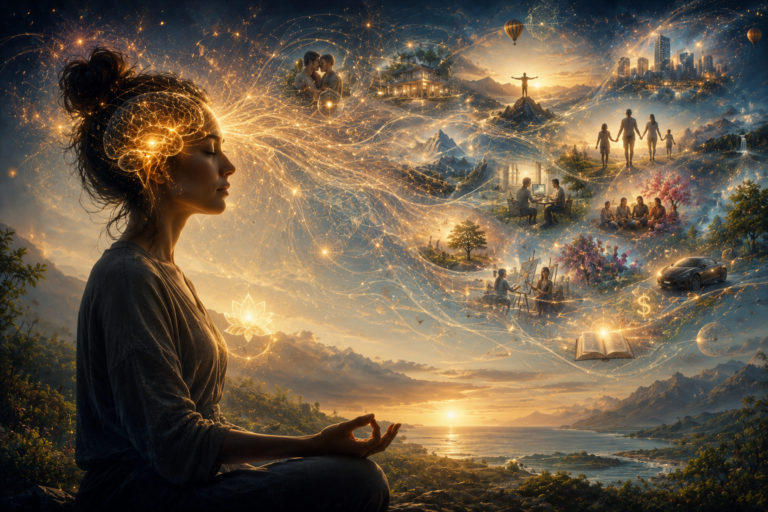
his brings us back to an idea explored in The World Your Brain Creates. The brain is not simply a window through which an independent reality pours. It receives limited sensory information and interprets it using neural processes influenced by biology, previous experience, context and expectation. What we consciously experience may therefore be better understood not as reality in its entirety, but as an extraordinarily useful human representation of it. And that representation divides the world into things.
This is the table. That is the chair. This is the tree. That is the sky. These distinctions are enormously useful. But usefulness and fundamentality are not the same thing.
Consider the tree. Where exactly does it end? At its bark? What about its roots intertwined with fungi beneath the soil? The carbon it absorbs from the atmosphere? The sunlight driving photosynthesis? The water moving through its tissues? The microorganisms living upon and within it? Remove those relationships and the apparently independent object called “tree” becomes increasingly difficult to define.
The boundary is useful. But nature may be less interested in our boundaries than we are.
And now we have arrived at the same question from two very different directions. Physics challenged our intuitive picture of what an object is. Perception challenged our confidence that the world appears to us exactly as it is. Eastern philosophy challenged the assumption that things exist independently in the first place.
What happens when we place those questions beside one another?
A Universe of Relationships
This is where science and Eastern philosophy can sit beside one another without pretending they are saying the same thing. Quantum physics does not prove Buddhism. Buddhist philosophy did not predict quantum field theory. Trying to force the two together diminishes both. They arose from different methods, different questions and very different traditions.
But they can provoke a remarkably similar question: Are separate things as fundamental as they appear?
Modern fundamental physics describes nature through fields and interactions rather than only as a collection of tiny solid objects. Eastern philosophy has long questioned whether phenomena possess independent, permanent existence. Neuroscience shows us that conscious perception emerges only after physical signals have been transformed and processed by a nervous system. None of these tells us that reality does not exist. But together they give us reason to question the ordinary picture of reality as a collection of completely separate, self-contained things presented directly to an observer.
Perhaps reality is less like a warehouse filled with objects and more like an unfolding network of relationships, interactions and processes.
What, Then, Actually Exists?
Perhaps even that question contains an assumption. We tend to think that something must either exist as a thing or not exist at all. But reality may not be so binary. A wave exists.
A rainbow exists. A flame exists. A whirlpool exists. Yet none needs to be a permanent, self-contained object in order to be real.
Consider a rainbow. It depends upon sunlight, water droplets, geometry and an observer positioned appropriately. There isn’t a rainbow sitting somewhere in space like a chair waiting to be discovered. Change the relationships and the rainbow disappears. That doesn’t make the rainbow unreal. It makes it relational. Perhaps many things are more like this than we imagine. Not independent substances. But temporary patterns arising through relationships.
So Is the Universe a Void?
This was the question that started this exploration. If matter loses its familiar solidity when examined deeply, if empty space is not really nothing, if objects depend upon relationships, and if perception gives us only a biologically mediated experience of reality, perhaps the universe is some kind of enormous void.
But void may be the wrong word. Nothing we have explored suggests that nothing exists. Quite the opposite. Something clearly exists. Things happen, fields interact, stars form, life emerges, brains perceive, experiences occur and so on.
What becomes uncertain is not whether reality exists. What becomes uncertain is whether reality is divided into the independent “things” our minds so naturally perceive.
Perhaps the mystery is not that there is nothing beneath everything. Perhaps the mystery is that beneath the apparent separateness of everything lies a reality our ordinary faculties were never designed to comprehend.
The Emptiness Beneath Everything
There is an old question in philosophy: Why is there something rather than nothing? It may be one of humanity’s deepest questions. But perhaps another question is hiding beneath it.
What do we actually mean by something? We look at the universe and see billions upon billions of separate things – Stars, planets, mountains, trees, animals. tables, people….Yet beneath those divisions, reality may not resemble an inventory of independent objects at all.
There are fields, interactions, relationships, processes & patterns appearing, changing and disappearing.
The ancient language of Buddhist philosophy spoke of emptiness. Modern physics uses very different concepts and methods. Neuroscience investigates how physical signals become the experienced world. They should not be confused with one another. And none establishes that the universe is literally “nothing.” But together they invite us to loosen our grip on something we normally take completely for granted: what it means for a thing to exist.
The table remains a table. The wave remains a wave. The tree remains a tree. At the level of reality in which those distinctions have meaning, they are perfectly real. But perhaps none is quite as separate, permanent or self-contained as it appears.
There is an ancient parable of several blind men encountering an elephant. One touches the trunk and describes the elephant one way. Another feels a leg and reaches a very different conclusion. Another encounters the ear, another the tusk. Each describes something real, yet none encounters enough of the elephant to describe the whole. Perhaps our relationship with reality is not entirely different.
Our senses reveal something real. Science extends their reach enormously. But we still encounter the universe through the particular faculties available to us, from a particular scale and perspective. Like the men touching the elephant, we may not be mistaken about what we perceive. We may simply be mistaking a part of reality for the whole.
Perhaps the deepest mystery of the universe is not why there is something rather than nothing. Perhaps it is why emptiness appears to us as so many separate somethings.



One Comment