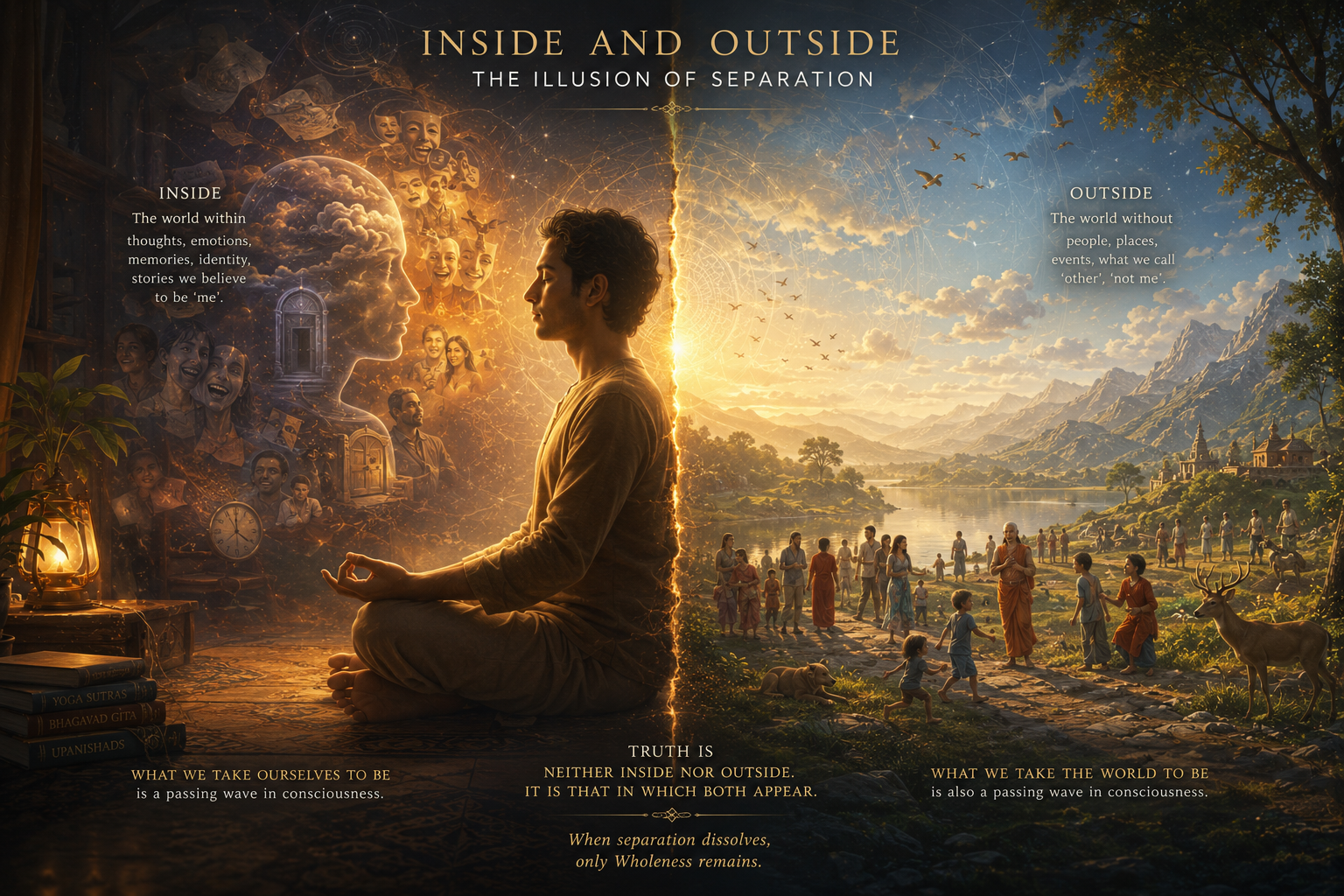
Inside and Outside: The Illusion of Separation
Perception • Consciousness • Reality
From the moment we are born, we experience life through a quiet assumption:
“I am in here.
The world is out there.”
It feels obvious. There is a self behind the eyes, looking outward at people, objects, and events unfolding in space. The observer appears separate from what is observed. But what if this division is not as real as it seems?
The World We Think We See
Everything we call “the world” arrives through experience. Light enters the eyes. Sound becomes sensation. The brain assembles patterns, colors, depth, movement, meaning.
What we experience is not reality itself—but reality translated through perception.
Modern neuroscience and physics increasingly suggest that the world we experience is deeply shaped by the observer. Space, color, time, even solidity—may not exist exactly as we perceive them.
The deeper science looks, the more reality begins to resemble interaction, relationship,
and observation—rather than separate independent objects.
The Quantum Mirror
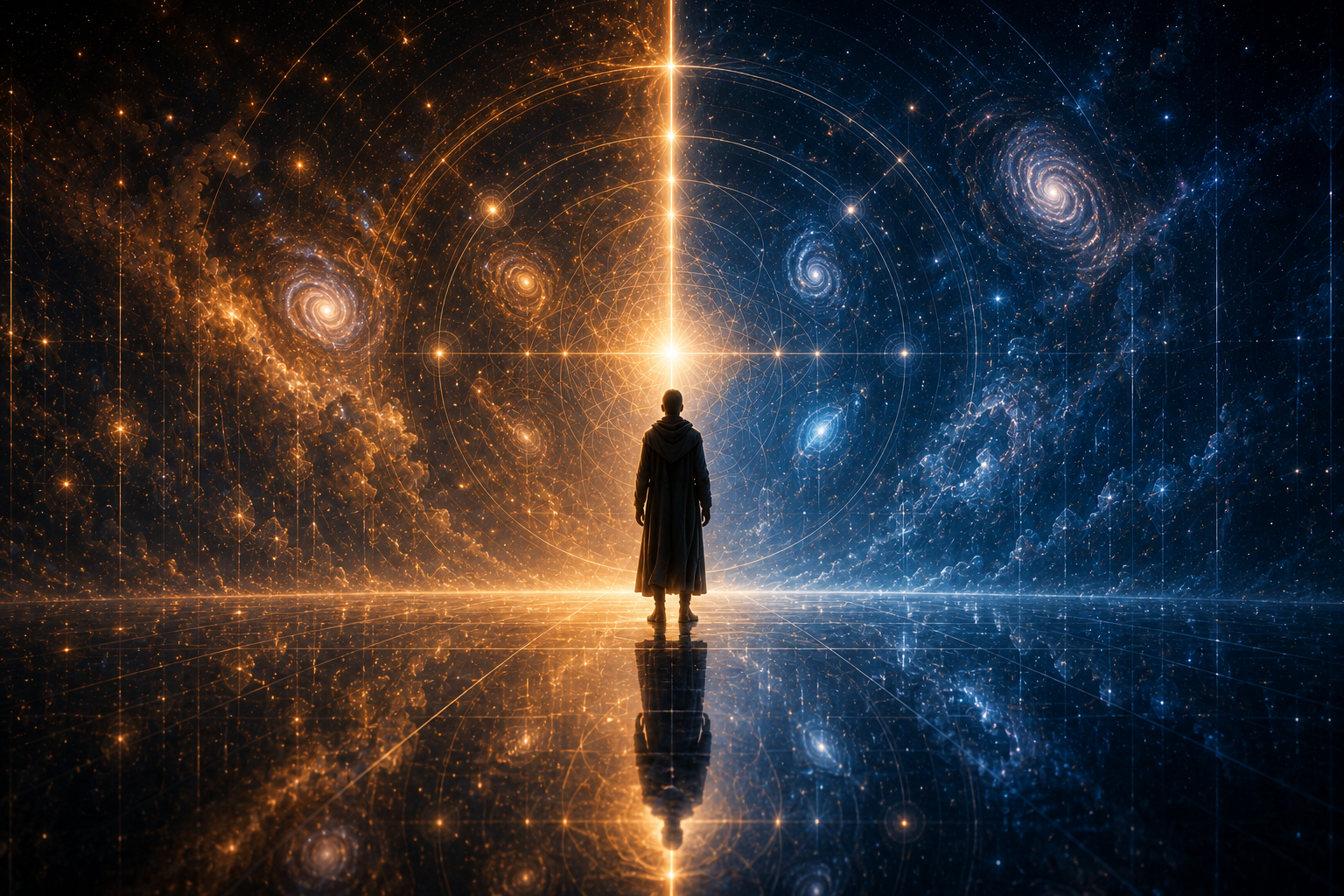
Quantum physics unsettled one of humanity’s oldest assumptions: that reality exists in a fully defined state independent of observation. Particles behave like probabilities. Possibilities collapse into measurable outcomes only through interaction. At the smallest scales, the universe appears less like solid matter—and more like potential waiting to be experienced.
The observer is no longer completely separate from the observed. In subtle but profound ways, they participate in the same event.
The Experiment That Changed Everything
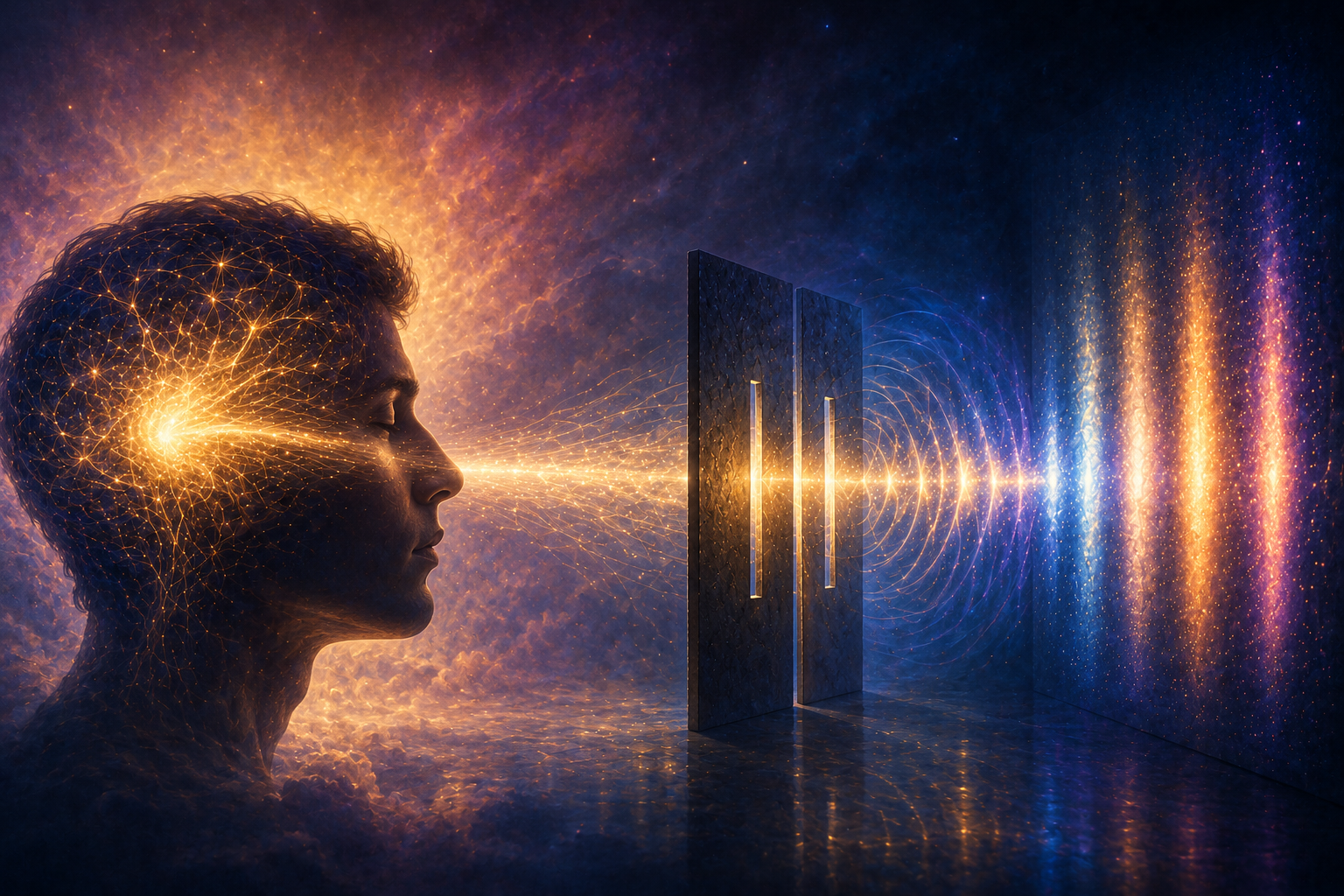
One of the strangest discoveries in modern physics came through a deceptively simple experiment: the double-slit experiment. When particles such as electrons are fired through two slits without observation, they behave like waves—spreading across possibilities simultaneously.
But when scientists attempt to observe which slit the particle passes through,
the behavior changes.
The wave collapses. The particle appears to “choose.” Observation itself seems to influence reality.
For many physicists, this was deeply unsettling. The universe no longer behaved like a machine operating independently of awareness. Instead, the observer appeared woven into the experiment itself.
The implications remain debated even today. But the experiment revealed something profound: Reality may not be as fixed and independent as human beings once believed.
Einstein’s Unease
Even Einstein struggled with the strange implications of quantum physics.
He famously asked: “The most incomprehensible thing about the universe is that it is comprehensible.”
And when confronted with the uncertainty and observer-dependent nature of quantum mechanics, he resisted the idea that reality could be fundamentally probabilistic.
“God does not play dice with the universe,” he said.
Yet the deeper science explored reality, the stranger reality became. Solid matter dissolved into energy. Certainty dissolved into probability. And separation itself began to blur.
What Eastern Philosophy Saw Long Ago

Long before modern physics, Eastern philosophies questioned the division between self and world. In Buddhism, the separate self is seen as a construction of the mind. In Advaita Vedanta, the distinction between observer and reality dissolves entirely.
The wave believes itself separate from the ocean—until it realizes it was never separate at all.The problem is not perception itself. The problem is forgetting that perception is incomplete.
Inside and Outside
Perhaps the boundary between “inside” and “outside” is not fixed.
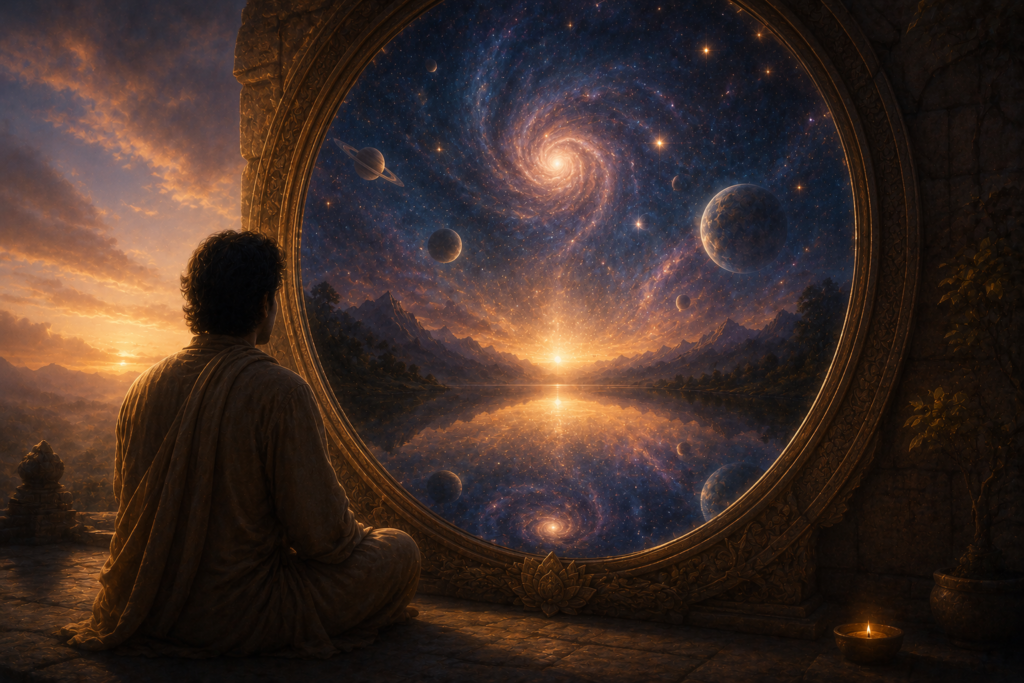
The stars we see exist within awareness. The universe appears inside consciousness
as experience. And the body itself—made from ancient stars—is not separate from the cosmos observing it.
The deeper we look, the stranger the question becomes:
Are we beings inside the universe—or is the universe appearing within us?
The Final Reflection
The moment we stop seeing ourselves as separate from reality—the world begins to feel profoundly alive.