
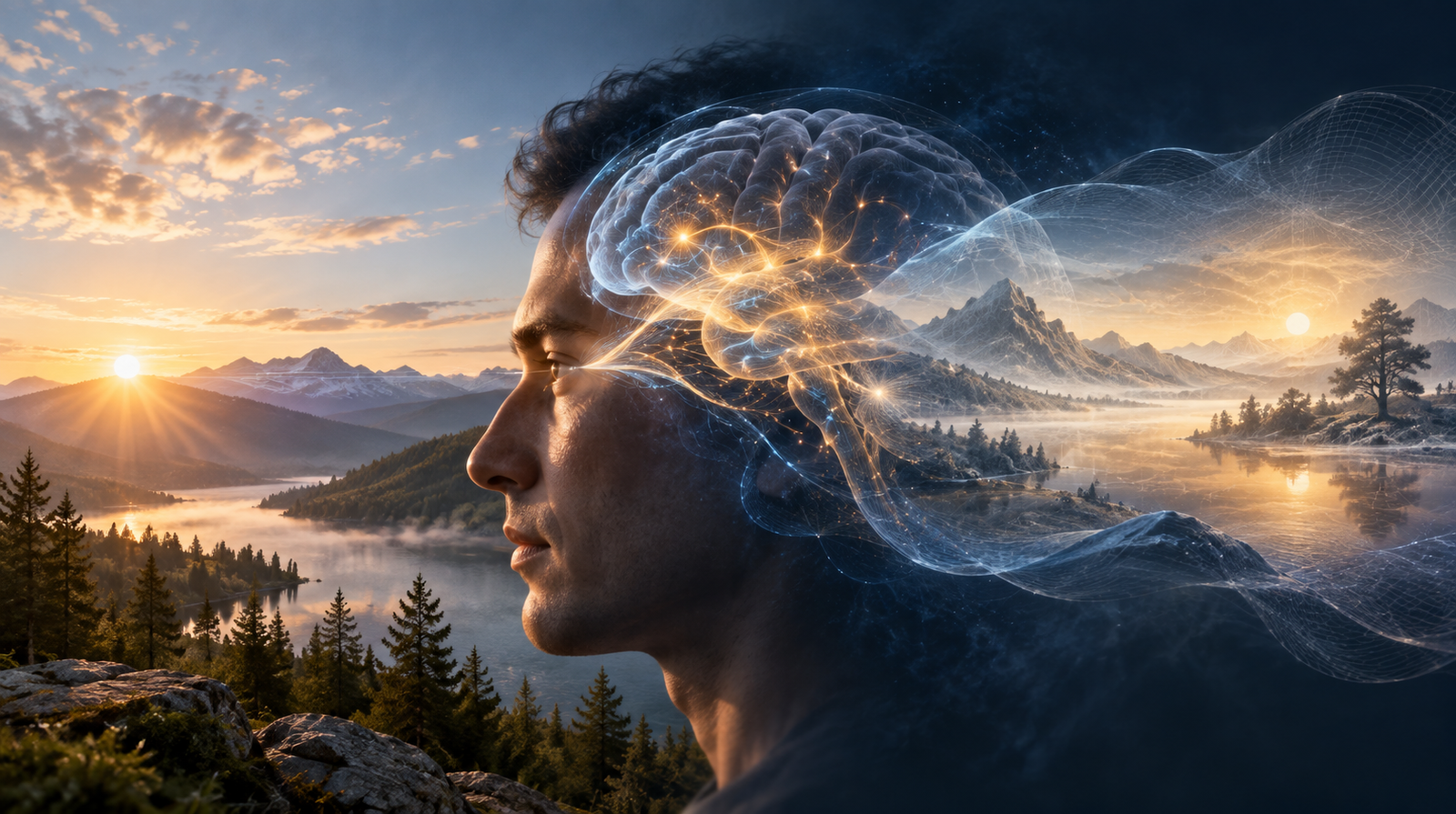
The World Your Brain Creates
What neuroscience, ancient philosophy, and a simple illusion can tell us about reality
You are looking at these words. It seems like the simplest thing in the world.
Light reaches your eyes. Your brain processes the information. And you see the words on the screen. Reality comes in. Experience comes out. Except that may not be quite how perception works.
One influential framework in neuroscience, known as predictive processing, proposes that the brain is not merely a passive receiver of information from the outside world. It uses prior experience and incoming sensory information to form expectations about what is out there.
From this perspective, perception is less like a camera recording the world and more like an ongoing negotiation between what the senses are telling us and what the brain expects those signals to mean.
Predictive processing is not a universally accepted explanation of perception. It represents a family of related theories, and neuroscientists continue to debate exactly how broadly the framework applies.
But the larger idea raises a profound possibility: The world we consciously experience is not simply reality delivered intact to the mind. Our experience of it is shaped by the machinery doing the perceiving.
The Brain That Predicts
Imagine walking through your house late at night. The room is dark. In the corner you see a figure. For an instant, there is no doubt. Someone is standing there. Your body reacts before you have time to reason about it.
Then you switch on the light. It is your coat hanging over a chair. The coat didn’t change. Your perception did. Faced with incomplete sensory information, your perceptual system rapidly settled on an interpretation consistent with the information available. Then more information arrived. The interpretation changed.
Predictive processing offers one way of explaining how something like this might happen. Rather than reconstructing the world from scratch at every moment, the brain can use previous experience and context to anticipate the likely causes of sensory signals.
Usually this works extraordinarily well. It has to.
The brain must rapidly determine what matters, what can be ignored, what might be dangerous, what is familiar and what may happen next. But it introduces an intriguing possibility.
Perhaps we never experience the external world entirely free of interpretation. Perhaps what we experience is the brain’s best current model of it.
Reality Pushes Back
his doesn’t mean reality is imaginary. If you walk toward a doorway that isn’t actually there, reality provides rather persuasive feedback.
Within predictive-processing theories, an important concept is prediction error. The brain forms expectations; sensory information arrives; and when the two don’t match, the discrepancy can help update the model.
The precise mechanisms remain subjects of scientific debate. But the broader point is well established: perception is not simply a neutral recording of sensory input. Context, expectation, prior experience and the structure of our sensory systems can influence what we perceive. Which raises an ancient question in surprisingly modern language: If everything I experience is shaped by the perceptual machinery of my nervous system, have I ever experienced reality exactly as it is?
A Philosopher Might Recognize the Question
Long before neuroscience existed, Indian philosophers questioned whether ordinary human perception reveals reality exactly as it is. One concept associated with this question is Maya.
Maya is often translated simply as “illusion,” but that can be misleading. It need not mean that the world does not exist. The deeper philosophical challenge is whether the world as we ordinarily experience and categorize it should be confused with reality in its ultimate nature.
We divide experience into objects, names and categories. We distinguish self from other, past from future, permanent from impermanent. Our minds organize experience into a world that seems obvious and self-evident. But does that world reveal the fundamental nature of reality—or the way reality appears to creatures like us?
Placed beside modern neuroscience, the comparison is fascinating. But we should be careful. Predictive processing does not prove Maya.
Ancient Indian philosophers did not discover predictive coding thousands of years before neuroscience. They were asking different questions, using very different methods.
Yet there is an intriguing point of contact: Our experience of reality and reality itself may not be identical.
The Redness of Red
Consider something as ordinary as color. There is no “redness” traveling through space from an apple into your mind. There is electromagnetic radiation. Objects reflect and absorb different wavelengths. Photoreceptors respond to that light, and neural systems transform those signals.
Somewhere within that extraordinary interaction, you experience: red.
The experience is real. But the redness you experience is not simply a tiny copy of an external property delivered unchanged into consciousness. It depends upon the perceptual system encountering the physical world.
Other creatures inhabit remarkably different sensory worlds. Some animals detect ultraviolet light. Some perceive polarization patterns invisible to us. Bats navigate using reflected sound. Some snakes can detect infrared radiation.
The physical environment may be shared, but different organisms have access to very different aspects of it. So which creature experiences reality as it “really” is?
Perhaps the question itself contains a hidden assumption. Each nervous system reveals some aspects of the world and leaves others completely inaccessible. Evolution did not necessarily build brains to contemplate reality objectively. It favored organisms capable of surviving and acting within it.
And Then There Is the Self
This is where the question becomes more uncomfortable. Because the brain doesn’t only maintain models of things outside us. It must also keep track of something much closer YOU: your body, your location, your memories, your intentions, your relationships and your history.
And somehow, across all of this change, there persists the familiar experience: I am me.
We normally assume that behind our experiences there must be a stable observer—the “I” to whom everything is happening. Buddhist philosophy famously asks us to examine that assumption. The doctrine of anatta, commonly translated as “not-self” or “no-self,” challenges the idea of a permanent, independent self underlying experience.
Look closely, the argument suggests there are sensations, thoughts, memories, emotions, intentions and awareness. But where exactly is the unchanging owner of them?
Again, neuroscience does not prove Buddhist philosophy. But an interesting question emerges. If the brain continually maintains models that help us navigate the external world, might our experienced sense of self also involve a continuously updated model—one that organizes perception, memory and action? If so, perhaps the self is real in something like the way a map is real: useful, consequential, sometimes indispensable. But not identical to the territory it represents.
Your Reality Is Not My Reality
There is also a more everyday implication. Two people can witness the same event and sincerely experience it differently. They bring different histories, expectations, memories, emotional states and assumptions to what they perceive. This does not mean every interpretation is equally accurate. Reality still pushes back. Evidence matters. But perception is not a perfectly transparent window through which identical information passes into every human mind. We bring something to the act of seeing. Perhaps that should make us a little more humble about certainty.
But There Is a Trap Here
It is tempting to take all this one step further: “If the brain constructs reality, then reality is whatever we believe it is.” That does not follow. Your brain may perceive a staircase in the darkness where none exists. Your foot will discover the error.
The fact that perception is constructed does not mean there is no external world. Nor does predictive processing demonstrate that consciousness creates physical reality, that thoughts directly alter external events, or that quantum mechanics makes subjective belief physically real. Those are separate claims requiring separate evidence.
The mystery is interesting enough without adding conclusions the science does not support.
The World Before the Mind
And so we arrive at a peculiar situation. Everything you have ever seen has been seen through a human visual system. Everything you have ever heard has passed through a human auditory system. Everything you have ever touched has been transformed into neural signals. You have spent your entire life experiencing reality from the perspective of one particular kind of organism. Yet we know there is more to the physical world than our senses reveal.
Telescopes detect light our eyes cannot see. Microscopes reveal structures our senses could never resolve. Mathematics describes scales and relationships human intuition struggles to imagine. Science is, in one sense, humanity’s extraordinary attempt to reach beyond the limitations of ordinary perception. And yet every discovery eventually returns to experience: an image, a number, a thought, Something appearing within consciousness. Which leaves us with a question neither neuroscience nor ancient philosophy has finally settled:
What is reality like before a mind experiences it?
Perhaps science will someday help us answer that question. Perhaps it cannot be answered in principle. Or perhaps the question itself will eventually turn out to be wrong. For now, we are left with a simpler thought. The world we experience is coherent enough for us to navigate, survive, build civilizations and discover galaxies billions of light-years away. But usefulness and completeness are not the same thing. There may always be a distance between reality—and reality as it appears to us.
Seeing is not necessarily the same thing as seeing things as they are.