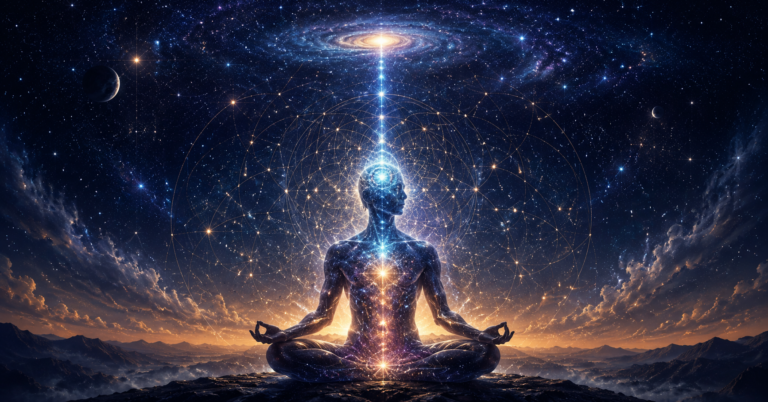
From Kali to Shiva: Energy, Awareness, and the Balance of Reality
There are moments in life when everything feels in motion. Thoughts arise one after another. Emotions intensify. Circumstances shift in ways that feel difficult to control. And then, sometimes, there is stillness.
A quiet awareness that remains, even as everything else continues to move. Across Hindu philosophy, these two aspects of experience are symbolized through Kali and Shiva.
Not simply as deities, but as expressions of something fundamental to how reality is experienced.
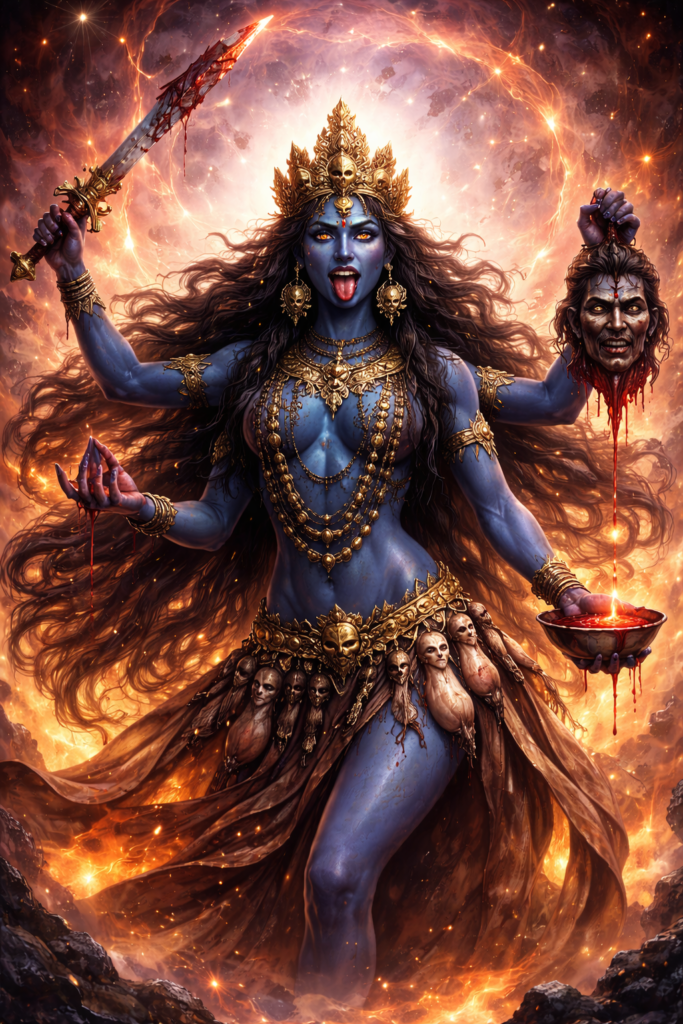
Kali: The Force of Change.
Kali represents movement, intensity, and transformation.
She is often associated with destruction—but not as something negative. Rather, she represents the breaking down of what is no longer stable. Old patterns dissolve. Identities shift. Structures that once felt permanent begin to fall away. This can feel chaotic. But it is also necessary.
Kali is not destruction for its own sake. She is the energy of change—the force that ensures nothing remains fixed.
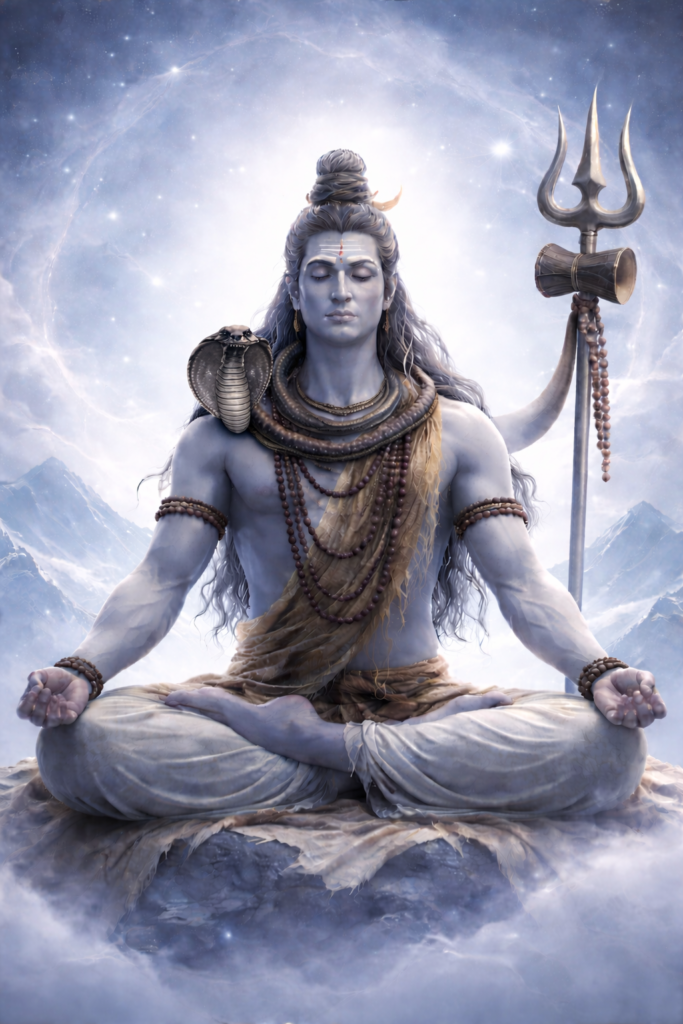
Shiva: The Ground of Awareness
Shiva represents something entirely different. Stillness. Presence. awareness.
He does not act—he observes. He is not caught in movement but remains as the space in which movement happens. If Kali is everything that is changing, Shiva is what remains unchanged. Not as an object or entity—but as awareness itself.
Not Two Forces, But One Reality
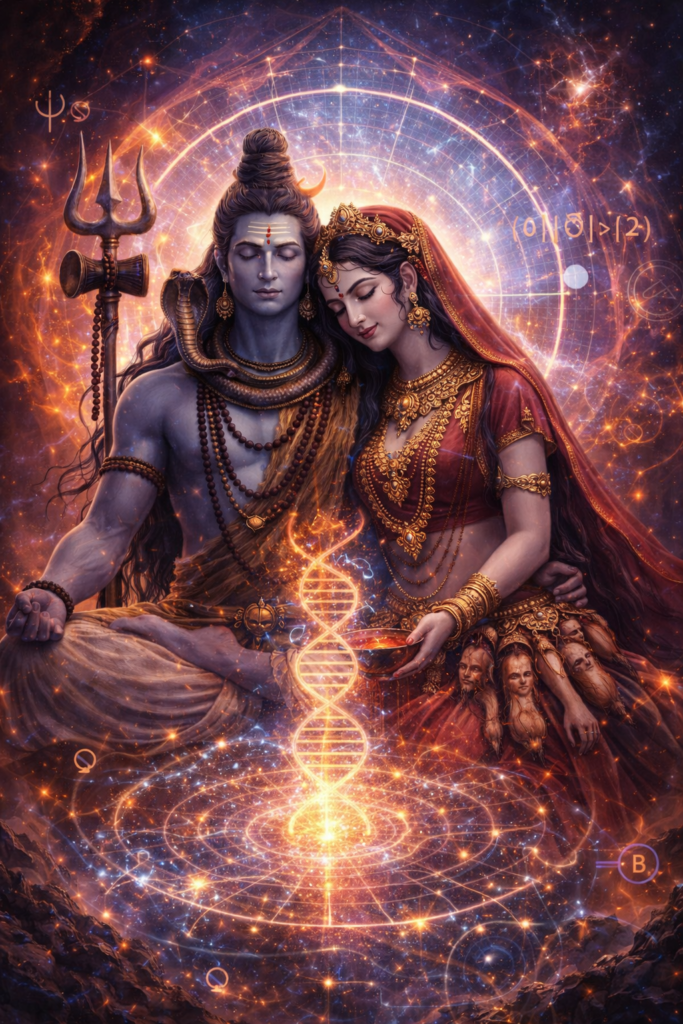
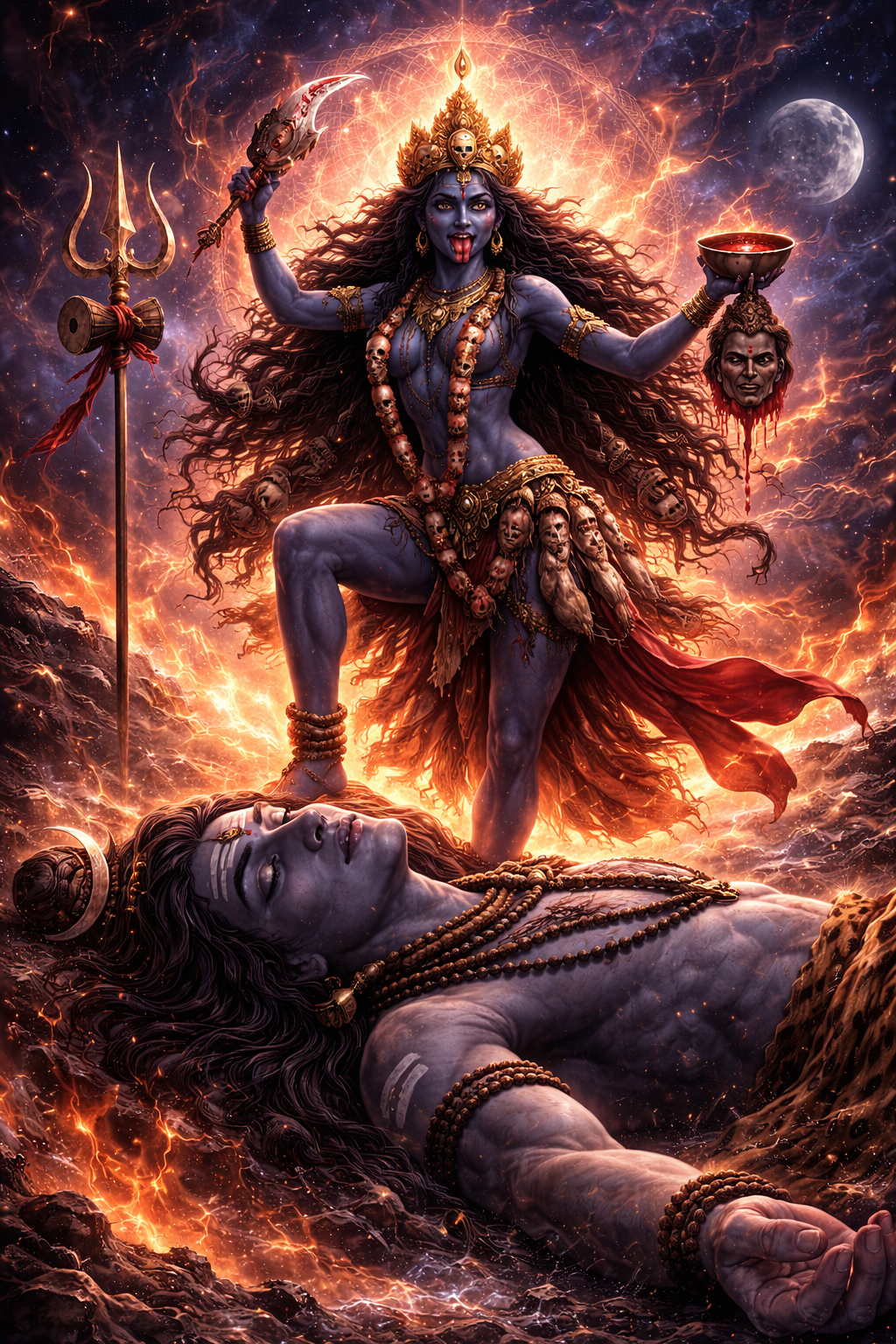
At first, these may appear as opposites. Movement and stillness. Change and permanence. But they are not separate. In traditional imagery, Kali is often shown standing on Shiva. This is not a symbol of dominance, but of relationship. Energy arises within awareness. And awareness expresses itself through energy. Without awareness, movement could not be known. Without movement, awareness would remain unexpressed. They are not two different realities— but two inseparable aspects of the same whole.
In the mythology of Kali, the wild and terrifying form of the Goddess, we see what happens when Shakti becomes untethered. She emerges to destroy evil—but in her fury, loses control and threatens the very fabric of existence.
No god can stop her—until Shiva, in his stillness and awareness, lies down in her path. The moment Kali steps on him, she becomes aware. Her rage subsides. She remembers herself.
This isn’t just mythology—it’s a powerful metaphor: when energy (Shakti) lacks awareness (Shiva), it can become destructive. The same force that creates can also consume.
⚡ To wield the raw power of Shakti, one must be as competent, still, and self-aware as Shiva. Without the depth and discipline of consciousness, unchanneled power becomes chaos.
Feminine and Masculine as Principles
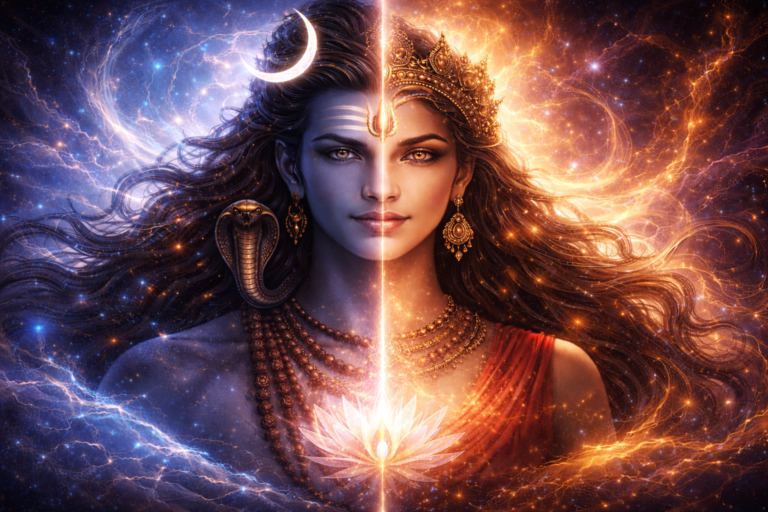
In Hindu philosophy, this relationship is often expressed through feminine and masculine principles. The feminine, represented through Shakti—of which Kali is one form—is the principle of energy, movement, and creation. It is everything that changes, evolves, and expresses itself. The masculine, represented by Shiva, is the principle of awareness—still, unchanging, and observing. These are not gendered roles. They are fundamental aspects of reality. The feminine is not limited to women, nor the masculine to men. Both are present in everyone, in every moment. Every thought, emotion, and action reflects movement. And every experience, no matter how dynamic, appears within awareness. In this sense, the feminine and masculine are not separate forces. They are two expressions of the same underlying reality.

A Modern Reflection
Modern science has become extraordinarily precise in describing activity. Neurons fire. Signals travel. Patterns emerge. We can map thoughts to regions of the brain. We can observe behavior down to milliseconds. But one question remains unresolved:Why is any of this experienced at all? Why is there awareness of these processes?
Science can describe what is happening. It cannot fully explain the fact that it is known. This creates a subtle but profound distinction. There is activity. And there is the awareness of activity. The first can be measured. The second cannot be easily located. This is not a flaw in science—it is a boundary. And it echoes what older traditions pointed toward in a different way: that what is observed, and the fact of observing, are not the same.
Kali is everything that moves. Shiva is that by which movement is known. Modern inquiry approaches this from the outside. Ancient inquiry approached it from within. But both arrive at the same edge: the recognition that awareness does not fit easily into the structures it observes.
The Balance
The movement from Kali to Shiva is not about choosing one over the other. It is not about rejecting life, thought, or emotion. It is about recognizing both. To see clearly the movement of experience. And at the same time, to recognize the awareness in which it unfolds. Not two separate realities—but a single, continuous whole. Always in motion. Always present.