After 25 Years of Solving Problems, I Started Asking Questions That Couldn’t Be Solved
For most of my adult life, I have been paid to solve problems. Technology problems. Business problems. Organizational problems. Problems involving systems so complicated that hundreds of people could spend years trying to make them work together.
There was always an objective. Something had to be designed, fixed, transformed, delivered or made better. And there was usually an answer. Perhaps not an easy answer. Perhaps not even the answer everyone agreed with. But somewhere, eventually, there was a solution. Yet the questions that increasingly occupied my mind were of a very different kind.
What exactly is consciousness?
What is the thing I call “I”?
Why does the universe exist at all?
Is reality fundamentally physical—or is our experience of the physical world only part of something much larger?
Why does time seem to move in one direction?
What happens to consciousness when the body dies?
And perhaps the most unsettling question:
What if some of the questions humanity has been asking for thousands of years cannot be solved at all?
I grew up in India, surrounded by philosophical traditions in which questions like these were not considered strange. The Upanishads asked what lies beneath the apparent self. The Buddha challenged the very idea that there is a permanent self to begin with. Taoist thinkers questioned our instinct to divide reality into neat categories.
Thousands of years later, science began approaching some of these questions from an entirely different direction. Physics dismantled our intuitive ideas about matter, space and time. Neuroscience began investigating how the brain constructs our experience of reality. Artificial intelligence has forced us to reconsider what intelligence actually means—and may eventually force us to confront what consciousness means. Cosmology has revealed a universe so enormous that the human mind struggles to comprehend it.
And yet, despite everything we have discovered, one extraordinary fact remains.
We are here.
We are conscious.
And we don’t really know why.
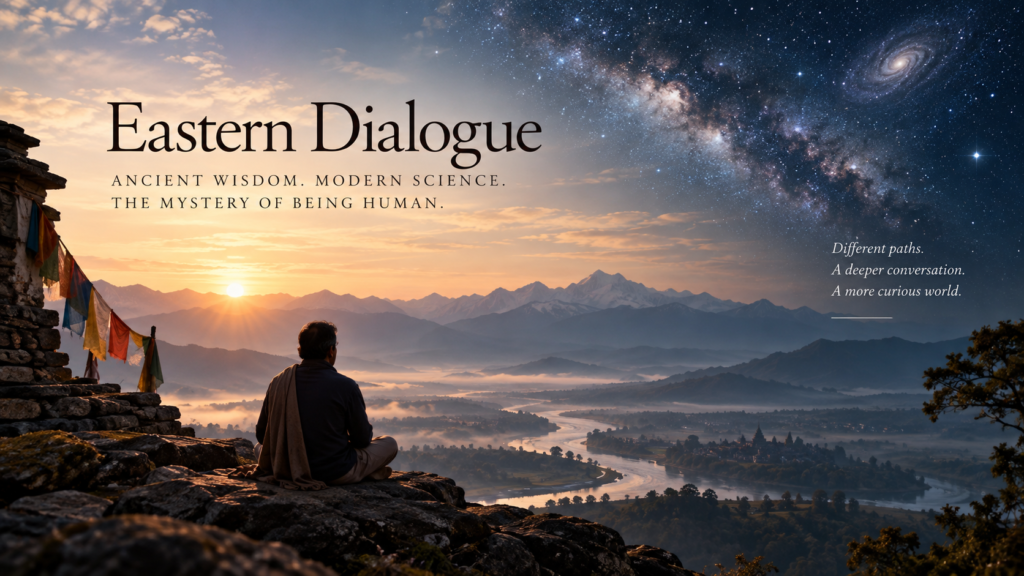
That mystery is where Eastern Dialogue begins.
It is not an attempt to prove that ancient philosophers somehow anticipated quantum mechanics. It is not an argument that science validates spirituality. And it is certainly not a place where every mystery will be explained by invoking the word “quantum.”
Science deserves better than that.
So does philosophy.
Instead, Eastern Dialogue is an exploration of what happens when we allow these different ways of understanding existence to sit at the same table. Sometimes they may illuminate one another. Sometimes they may contradict one another.
Sometimes the most interesting answer may simply be: We don’t know.
I have come to appreciate those three words.
For much of my professional life, not knowing was something to overcome. Today, I increasingly see it as the beginning of inquiry. I recently reached an unexpected transition in my own life. After more than twenty-five years working in technology, transformation and leadership, one chapter ended sooner than I expected. For the first time in a very long time, I found myself asking a different kind of question.
Not: What job comes next?
But: What do I want to spend the next part of my life thinking about?
I already knew the answer. These questions. The questions I return to while walking through the woods. The questions that arise while looking through my telescope on a clear, moonless night.
The questions hidden inside the little parables I have been writing. The questions my daughter sometimes asks that are considerably more difficult than anything I have encountered in a conference room.
Questions about consciousness.
Reality.
The self.
Life.
Death.
Meaning.
And this astonishing universe in which, for a brief period of time, each of us gets to open our eyes and wonder what is going on.
I don’t intend to approach these questions as a guru. I am not one. I approach them as a seeker. Eastern Dialogue will bring together philosophy, science, ancient wisdom, modern ideas and conversations with people who have spent their lives thinking deeply about these subjects.
There will be physicists and philosophers.
Scientists and contemplatives.
Skeptics and believers.
And occasionally there will simply be me, sitting with a question and seeing where it leads. I don’t expect every journey to end with an answer. In fact, I increasingly suspect that the most interesting ones won’t. Perhaps the purpose isn’t always to find the answer. Perhaps sometimes it is simply to learn how to ask a better question.