Where Philosophy Meets Science
At first glance, philosophy and science seem to belong to different worlds. One turns inward exploring meaning, experience, and the nature of reality through introspection. The other looks outward seeking to understand the universe through observation, measurement, and experimentation. But beneath these differences they are driven by the same pursuit: WHAT IS REAL?
Two Ways of Knowing
Two directions. One question
It is often assumed that to understand reality, we need to look outward. Measure it. Analyze it. Break it down. But what if that is only half the story? What if the nature of reality cannot be understood without also examining the one who is looking?
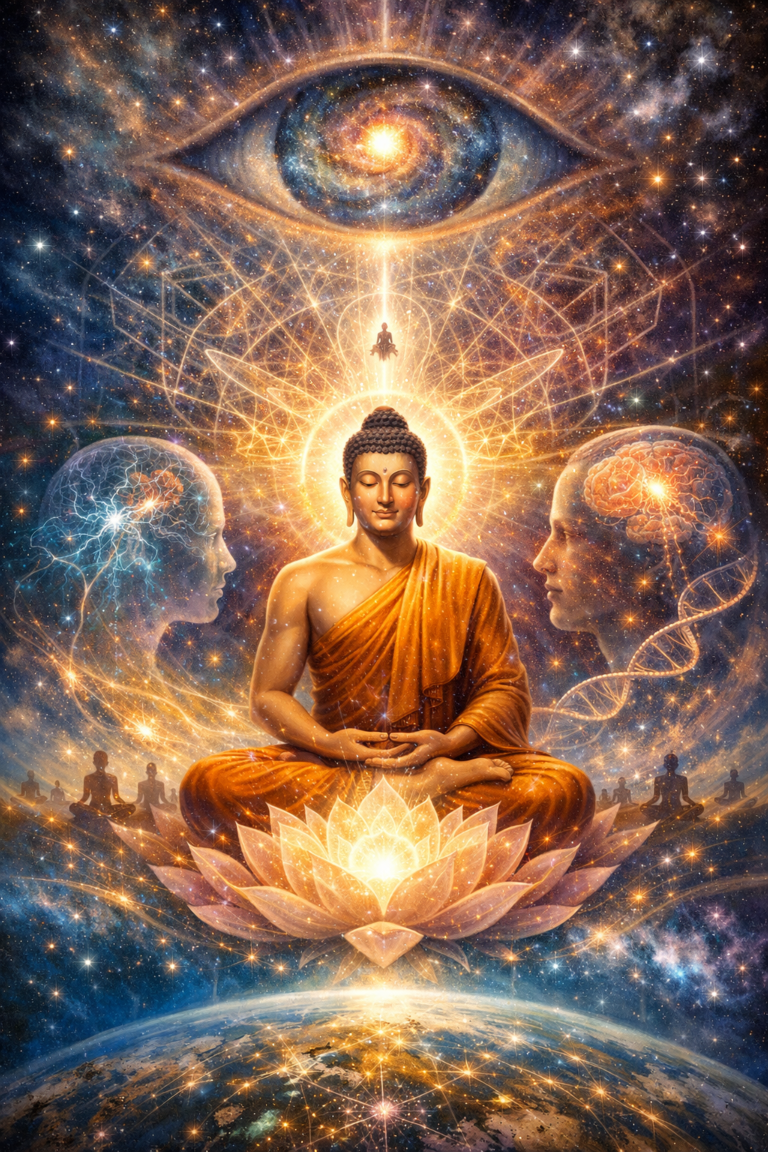
For centuries, science has moved outward – studying matter, energy, space, and time. It seeks to understand the structure of the universe through observation and measurement. Philosophy, particularly in traditions like Buddhism, moves in the opposite direction. Instead of examining the external world, it turned inward—toward perception, awareness, and the experience of being.
At first, these approaches seem fundamentally different. One relies on instruments. The other relies on introspection. One studies what can be observed. The other questions the nature of observation itself. And yet, something unexpected happens. The deeper science looks into matter, the less solid and independent it appears. The deeper philosophy looks into experience, the less fixed and separate the self appears. Both begin to challenge the same assumption: that reality is made up of clearly defined, independent things.
Bridging Insights
Where the two directions meet
Despite moving in opposite directions—one outward, the other inward—both begin to converge. The distinction between observer and observed becomes less clear. The boundary between inner experience and outer reality begins to blur. What we call “inside” and “outside” may not be fundamentally separate, but two ways of looking at the same underlying process.
Philosophy looked inward. Science looked outward. Both moved beyond the assumption of a solid, separate world.
This does not mean the two approaches are identical. But it suggests something deeper: that understanding reality may require both directions of inquiry—and that neither, on its own, is complete.
Points of Intersection
Where the parallels become real
When examined separately, philosophy and science seem to describe different worlds. But when placed side by side, certain patterns begin to emerge. Not identical conclusions—but similar directions of inquiry.
Impermanence → Entropy: One of the clearest parallels appears in how change is understood. In Buddhist thought, impermanence (anicca) is a fundamental characteristic of reality. Everything that arises passes away. Nothing remains fixed. In science, the Second Law of Thermodynamics describes a similar tendency: systems evolve over time, energy disperses, and structure gives way to transformation.
These are not the same frameworks—but both suggest something deeper: Stability is temporary – not fundamental.
The Nature of Self: The question of the self presents another point of overlap. Buddhist philosophy suggests that what we call the self is not a fixed entity, but a process—arising from changing conditions. Modern neuroscience similarly views identity as constructed—emerging from patterns of brain activity, memory, and perception.
In both cases, the self appears less like a stable core – and more like something continuously formed.
Interconnectedness → Entanglement: Another convergence appears in the idea of relationship. Philosophical traditions often describe reality as deeply interconnected—nothing exists independently, but only in dependence on other conditions. In physics, quantum entanglement describes correlations between particles that cannot be explained through classical notions of separation. While individual measurement outcomes are probabilistic, the relationships between entangled systems follow precise and testable patterns.
These are not the same concepts.
But both challenge the intuition: that things exist as isolated, self-contained entities.
Emptiness → Structure: Perhaps the most subtle parallel appears in the idea of emptiness. In Buddhism, emptiness (śūnyatā) does not mean nothingness. It points to the absence of inherent, independent existence. Things are not empty of being—but empty of fixed essence. In physics, what appears as solid matter is largely empty space—structured by fields, interactions, and probabilities.
As expressed in Buddhist thought: “Form is emptiness, emptiness is form.” What appears as structure is not separate from the absence of fixed essence—it arises from it.
Not an Answer — A Direction
These intersections do not suggest that philosophy and science are saying the same thing.
They are not.
But they often point in similar directions—toward a reality that is less fixed, less separate, and more dynamic than it first appears. Different methods. Different languages. But perhaps – a shared movement toward understanding.
Where This Becomes Visible
-
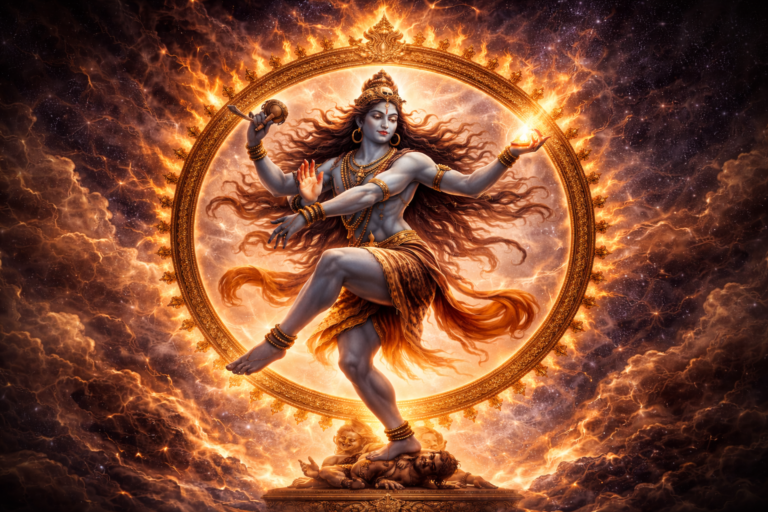
From Kali to Shiva: Energy, Awareness, and the Balance of Reality
From Kali to Shiva: Energy, Awareness, and the Balance of Reality There are moments in life when everything feels in motion. Thoughts arise one after another. Emotions intensify. Circumstances shift in ways that feel difficult to control. And then, sometimes, there is stillness.A quiet awareness that remains, even as everything else continues to move. Across…
-
Where is the “I”? Rethinking the Self
There is a sense most of us rarely question. The feeling that there is a “me”— a center from which thoughts arise, decisions are made, and life is experienced. It feels obvious. We say, “I think,” “I feel,” “I remember,” as though there is a stable entity behind these experiences, holding them together. But when…
-
What is Consciousness? A Simple Exploration
At some point, we begin to notice something subtle but persistent: we are aware. Not just of the world around us, but of our own thoughts, emotions, and experiences. This awareness feels immediate and undeniable—yet when we try to understand it, it becomes surprisingly difficult to define. What is consciousness? Is it something the brain…
-
Decay Is Inherent: A Buddhist Reflection on the Second Law of Thermodynamics
At some point, we begin to question the nature of change. What we take to be stable—our bodies, our thoughts, the structures around us—does not remain so. Over time, everything shifts, dissolves, or gives way to something else. This raises a deeper question: Is decay a failure of the system, or is it the system…
-
When the Universe Looks Back
The Hard Problem of Consciousness: The Mystery That Knows Itself We can peer into the brain with dazzling precision today. We can watch thoughts form as electric impulses, map emotions to circuits, and track how memories take shape in folds of gray matter. And yet, even with all our instruments and theories, we are no…