

The Archer Who Could Not Miss
A young archer traveled a long distance to train under a master. “I want to become perfect,” he said. “I want to hit the target every time.”
The master studied him for a moment, then nodded. “Very well,” he said. “Stand there.”
He pointed to a narrow wooden beam that stretched across a deep ravine. The wind moved gently through the trees below. The drop was far enough to make the archer hesitate.
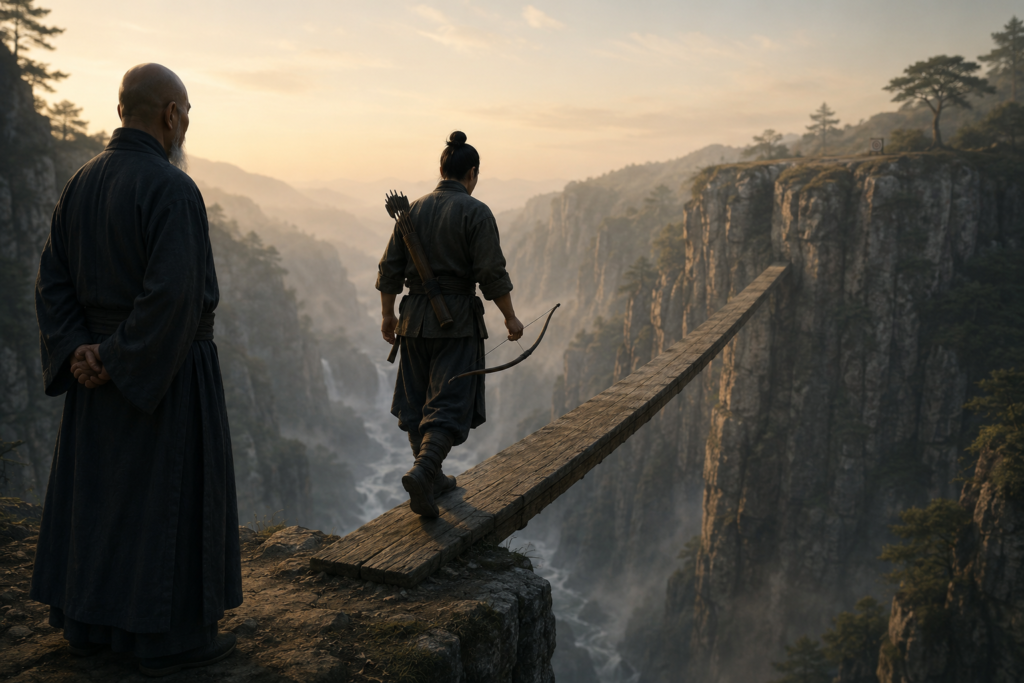
“Now,” the master said, handing him a bow, “shoot.”
The archer stepped onto the beam.
His hands tightened. His breath shortened.
The target, which had seemed so clear moments ago, now felt distant and unstable. He released the arrow.
It missed.
He tried again. And again. Each time, the same result. His focus was gone. His body was tense. The arrow no longer moved freely—it struggled, as he did.
Finally, frustrated, he stepped down.
“This is not fair,” he said. “The beam makes it impossible to focus.”
The master said nothing.
He took the bow and walked to solid ground.
Without hesitation, he lifted it and released an arrow.
It struck the center of the target.
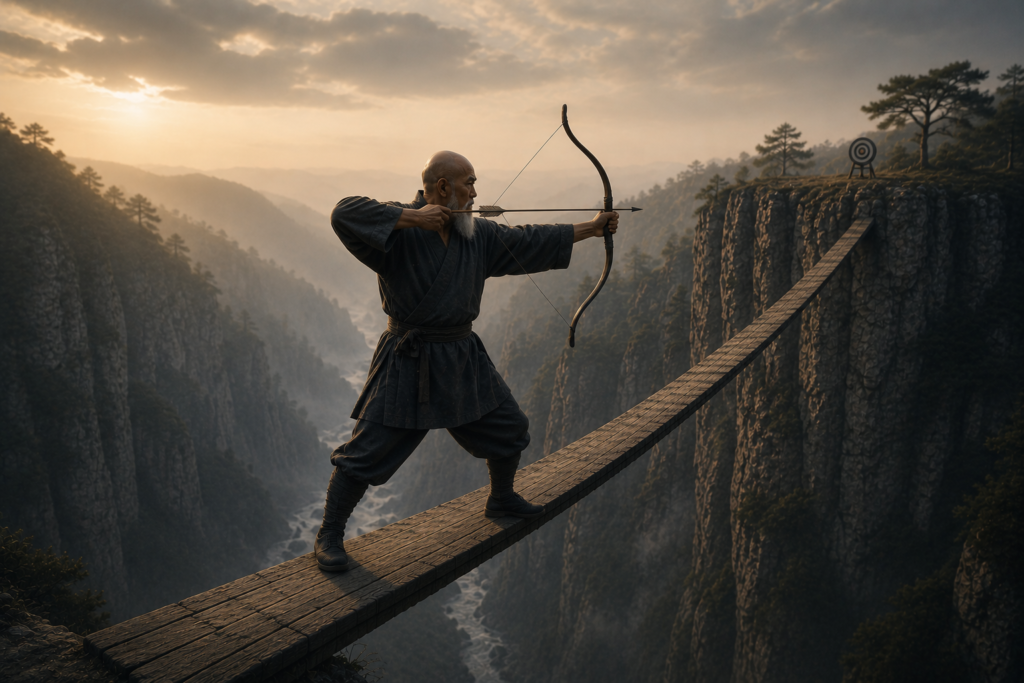
The master turned to him. “The target did not change,” he said. “The bow did not change.
The arrow did not change. Only your mind did.”
The archer looked back at the beam. “It is the fear of falling,” he said quietly.
The master shook his head.
“No,” he replied. “It is the thought of falling.”
The archer stood in silence. For the first time, he saw it clearly. The danger was real. But the disturbance came before anything happened. Before the fall. Before the miss. Before the moment itself. It began in the mind.

He stepped onto the beam again. The wind was the same. The distance was the same.
But something had shifted.
He did not try to control his thoughts. He did not try to eliminate fear. He simply saw them—as they arose.
The arrow was released. It moved without hesitation. And this time—it did not miss.
Mastery is not found in controlling the moment— but in seeing clearly what disturbs it.