
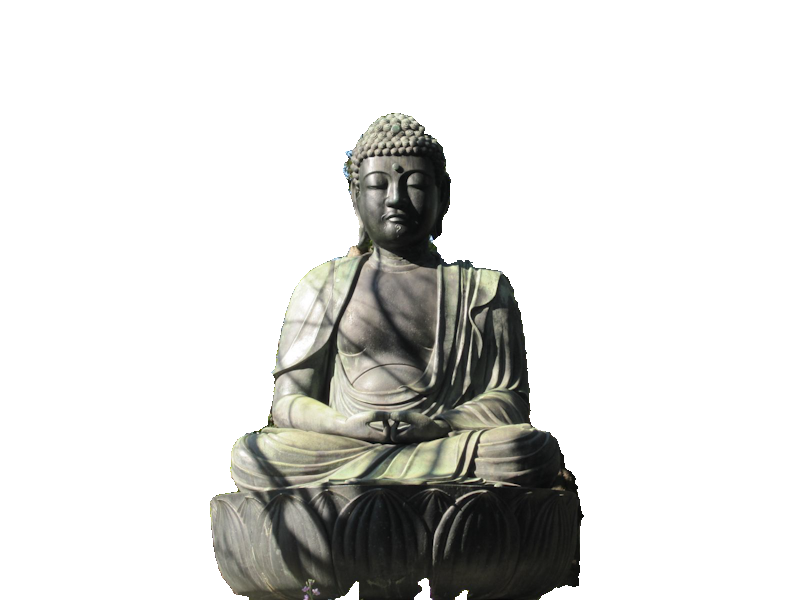
The Question the Buddha Would Not Answer
One evening, after the day’s alms were finished and the forest had gone quiet, a group of monks gathered around the Buddha. They had been arguing softly among themselves, circling the same questions again and again, like moths around a lamp.
Finally one of them spoke up.
“Teacher,” he said, “people keep asking us things we don’t know how to answer. They ask: Is there a God? Is there a heaven? Is there a soul that lives forever? What happens after death? Please tell us the truth.”
The others leaned in. These were big questions. Surely the Buddha, who seemed to see so clearly into the nature of things, would finally explain it all.
The Buddha listened without interrupting. When the monk finished, he picked up a small leaf from the ground and held it between his fingers.
“What do you think,” the Buddha asked gently, “are there more leaves in this forest, or more leaves in my hand?”
The monks smiled. “Of course there are more leaves in the forest, Blessed One.”
The Buddha nodded. “In the same way, there are many things that can be known, many mysteries about the universe. Some I understand. Some are beyond words. But what I teach is like this leaf—small, chosen, and purposeful.”
The monks looked puzzled.
He continued, “I do not teach whether the world is eternal or not. I do not teach whether the soul exists forever or vanishes. I do not teach about gods or heavens. Not because these questions are foolish—but because they do not lead to freedom.”
Seeing their confusion, the Buddha told them a story.
“Imagine a man walking through the forest who is suddenly struck by a poisoned arrow. His friends rush to help him, but the man says, ‘Wait. Before you remove the arrow, I must know who shot it. Was he tall or short? What was his caste? What kind of wood was the arrow made from? What bird were the feathers taken from?’”
The monks frowned. “He would die before getting answers.”
“Exactly,” said the Buddha. “In the same way, people are wounded by suffering—by fear, loss, craving, and death. Yet they refuse the cure until every cosmic question is answered. By the time the answers come, life is already over.”
He looked at them kindly.
“I teach suffering, and the end of suffering. I teach how the mind creates its own chains, and how those chains can be released. Whether gods exist or not, old age still comes. Whether heaven is real or not, grief still hurts. Whether the soul is eternal or not, anger still burns.”
The forest was silent.
“Do not worry about the shape of the universe,” the Buddha said softly. “Worry about the fire in your own heart. When the fire is out, peace remains. That peace does not depend on belief—it comes from understanding.”
The monks bowed, slowly realizing that the Buddha was not refusing their questions.
He was pointing them somewhere deeper—away from speculation, and toward freedom.
It was not that the Buddha lacked an understanding of the universe; rather, he considered speculative cosmology secondary to the immediate problem of human suffering. Teaching abstract theories about the nature or origin of the universe, while individuals remained bound by craving, ignorance, and distress, would have offered little practical value. The Buddha therefore focused on what could be directly known and verified through experience: impermanence, conditionality, and the causal processes that give rise to suffering and its cessation. His depiction of reality as dynamic, interdependent, and lacking any fixed or independent essence bears notable conceptual parallels to certain insights of modern physics, particularly the emphasis on relational processes and the absence of absolute, observer-independent structures. While the Buddha did not articulate a scientific model of the universe, his framework anticipates a view of reality as process-based rather than substance-based. The convergence lies not in shared terminology or methodology, but in a common departure from static, deterministic conceptions of existence toward an understanding of reality as contingent, evolving, and fundamentally interconnected.